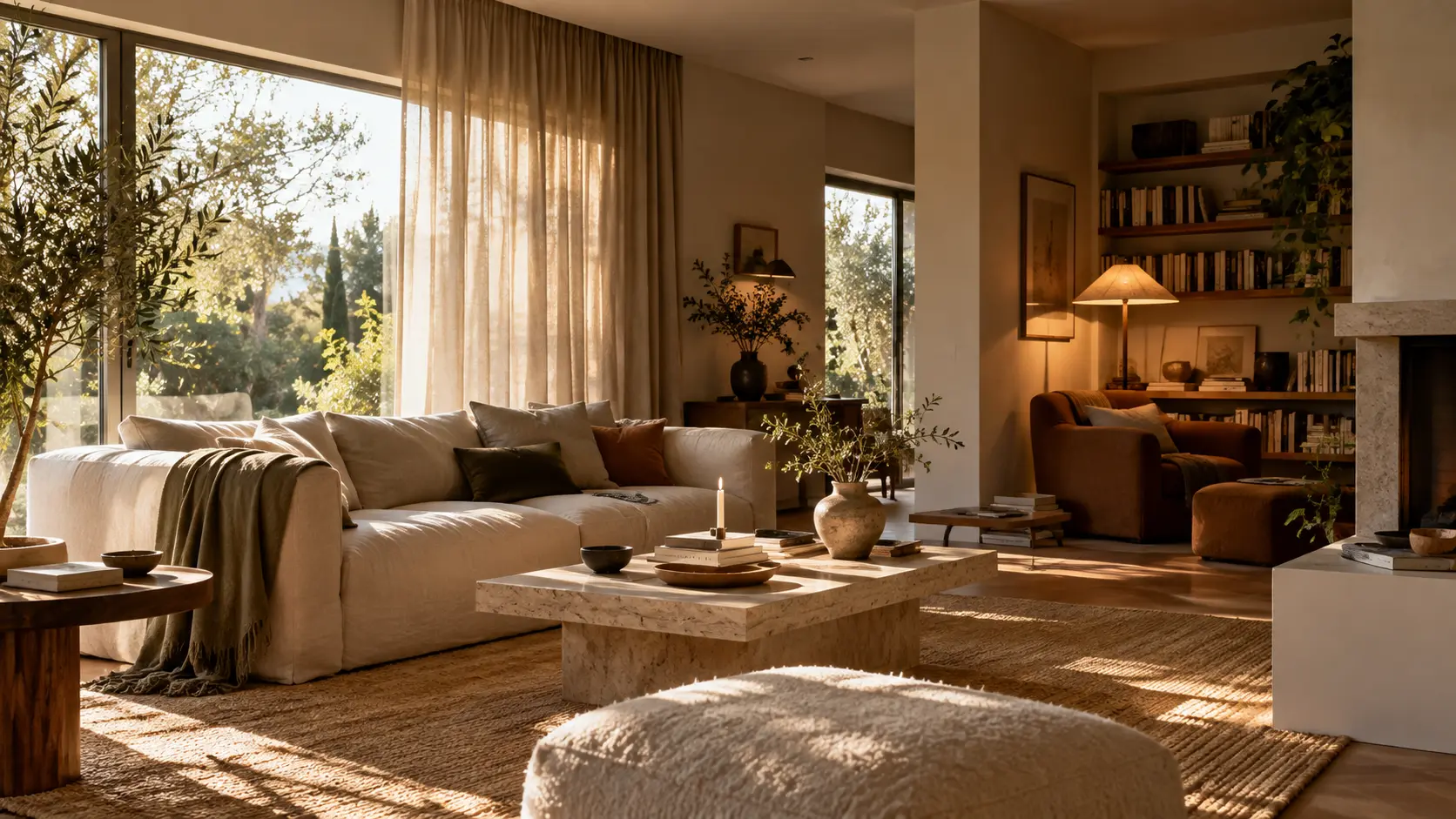
Think about a living room in the evening.
One person turns on the main light because the room feels too dark. Someone else switches it off five minutes later and turns on a smaller lamp instead.
One person likes having music in the background. Another finds it difficult to relax until the room is quiet.
Someone feels at home surrounded by books, photographs and objects collected over time. For someone else, the same room can start to feel visually crowded.
Nobody is necessarily right or wrong.
They are simply experiencing the same environment differently.
We don't all notice the same things
When we think about comfort at home, we tend to talk about it as though it were something universal.
A calming bedroom. A cosy living room. A productive workspace.
But what feels calming, cosy or comfortable depends partly on the person experiencing it.
Some of us notice sound very quickly. Others are more affected by light, visual activity, temperature, proximity to other people or the feeling of being exposed in a room.
Our habits matter too.
So do our memories, the activities we are doing and even what we need at that particular moment.
A bright kitchen might feel wonderful on a slow Sunday morning and far too stimulating late at night.
The same person can need something different from the same space only a few hours later.
And once several people share a home, things become even more interesting.
Sharing a home also means sharing sensory conditions
We usually negotiate the obvious parts of living together.
Who uses which cupboard. Where the sofa goes. Whether the television belongs in the living room. Who has taken over far too much wardrobe space.
What we rarely discuss are the less visible preferences.
- How much light feels comfortable?
- How much background noise is too much?
- Do we prefer doors open or closed?
- Do we like being in the middle of the room, or somewhere slightly more protected?
- How many things can be visible before a space begins to feel busy?
These differences can easily look like personal habits or small annoyances. Sometimes they are simply different ways of experiencing the environment.
This is where designing a shared space becomes less about finding one ideal atmosphere and more about allowing different needs to coexist.
Compromise is not always the most interesting answer
If one person wants bright light and another prefers a softer atmosphere, the solution does not necessarily have to sit exactly in the middle.
The room itself can offer more than one possibility.
A ceiling light can coexist with smaller lamps. An open living area can still contain a quieter corner. One seat can face the activity of the room while another feels slightly more sheltered. Personal objects can have a visible place without covering every surface.
Sometimes the smallest form of flexibility can make a surprisingly large difference.
Being able to move a lamp, close a curtain, choose another seat or retreat somewhere quieter gives us some control over our own experience without requiring everyone else to experience the room in exactly the same way.
Perhaps this is particularly important in shared homes.
Because living together does not mean needing the same things at the same time.
Maybe a good shared space is one that gives us choices
There probably isn't one version of a room that will feel perfect to every person who enters it.
And perhaps there doesn't need to be.
Instead of asking how to make everyone comfortable in exactly the same way, we can look at whether a space offers enough possibilities for people to adjust it, move within it and find the conditions that work for them.
- Can the lighting change throughout the day?
- Is there somewhere quieter to sit?
- Can you be together without always having to do the same thing?
- Is there room for different levels of stimulation?
- Can each person recognise something of themselves in the space?
These are small questions, but they change the way we think about shared interiors.
A home does not have to make everyone feel the same.
It can simply make room for the fact that we don't.
At Mind Friendly Spaces, this is one of the ideas behind looking at our relationship with space on an individual level. Understanding what we are sensitive to is not about creating a perfect environment around one person. It can also help us understand why someone else may experience the very same room differently.
Perhaps the better question is not:
How do we create the perfect room?
But:
How much choice does this room give the people who live in it?
Imaginez un salon en fin de journée.
Une personne allume le plafonnier parce qu’elle trouve la pièce trop sombre. Cinq minutes plus tard, quelqu’un d’autre l’éteint et préfère une petite lampe.
L’une aime entendre un peu de musique en arrière-plan. L’autre n’arrive à se détendre que lorsque la pièce est silencieuse.
Quelqu’un se sent chez soi au milieu des livres, des photographies et des objets rassemblés au fil du temps. Pour une autre personne, la même pièce peut vite sembler visuellement encombrée.
Personne n’a nécessairement raison ou tort.
Chacun fait simplement une expérience différente du même environnement.
Nous ne remarquons pas tous les mêmes choses
Lorsque nous parlons du confort à la maison, nous avons tendance à le présenter comme quelque chose d’universel.
Une chambre apaisante. Un salon chaleureux. Un espace de travail propice à la concentration.
Pourtant, ce qui nous paraît apaisant, chaleureux ou confortable dépend en partie de la personne qui vit l’espace.
Certains d’entre nous perçoivent très vite les sons. D’autres sont davantage sensibles à la lumière, au mouvement visuel, à la température, à la proximité d’autres personnes ou au sentiment d’être exposés dans une pièce.
Nos habitudes comptent elles aussi.
Tout comme nos souvenirs, l’activité du moment et ce dont nous avons besoin à cet instant précis.
Une cuisine très lumineuse peut être merveilleuse un dimanche matin tranquille et beaucoup trop stimulante tard le soir.
Une même personne peut avoir besoin de tout autre chose dans le même espace quelques heures plus tard.
Et dès que plusieurs personnes partagent un foyer, les choses deviennent encore plus intéressantes.
Partager un foyer, c’est aussi partager des conditions sensorielles
Nous négocions généralement les aspects les plus visibles de la vie à plusieurs.
Qui utilise quel placard. Où placer le canapé. Si la télévision a sa place dans le salon. Qui s’est approprié beaucoup trop d’espace dans l’armoire.
En revanche, nous parlons rarement de nos préférences moins visibles.
- Quelle intensité lumineuse nous convient ?
- À partir de quand le bruit ambiant devient-il trop présent ?
- Préférons-nous les portes ouvertes ou fermées ?
- Aimons-nous être au centre de la pièce ou dans un endroit un peu plus protégé ?
- Combien d’objets peuvent rester visibles avant que l’espace ne commence à paraître chargé ?
Ces différences peuvent facilement passer pour de simples habitudes ou de petits agacements. Elles sont parfois seulement le reflet de manières différentes de vivre un environnement.
Concevoir un espace partagé consiste alors moins à rechercher une atmosphère idéale qu’à permettre à des besoins différents de coexister.
Le compromis n’est pas toujours la réponse la plus intéressante
Si une personne souhaite une lumière vive et qu’une autre préfère une ambiance plus douce, la solution ne doit pas nécessairement se situer exactement entre les deux.
La pièce elle-même peut offrir plusieurs possibilités.
Un plafonnier peut coexister avec de petites lampes. Un séjour ouvert peut tout de même accueillir un coin plus calme. Un siège peut faire face à l’activité de la pièce tandis qu’un autre offre une sensation plus abritée. Les objets personnels peuvent être visibles sans occuper toutes les surfaces.
Parfois, une toute petite marge de flexibilité fait une différence étonnamment grande.
Pouvoir déplacer une lampe, fermer un rideau, choisir une autre place ou se retirer dans un endroit plus calme nous donne une certaine maîtrise de notre propre expérience, sans demander aux autres de vivre la pièce exactement de la même façon.
Cela est peut-être particulièrement important dans les foyers partagés.
Car vivre ensemble ne signifie pas avoir besoin des mêmes choses au même moment.
Un bon espace partagé est peut-être un espace qui nous laisse le choix
Il n’existe probablement pas une seule version d’une pièce qui conviendra parfaitement à chaque personne qui y entre.
Et ce n’est peut-être pas nécessaire.
Au lieu de chercher à mettre tout le monde à l’aise de la même manière, nous pouvons nous demander si l’espace offre assez de possibilités pour que chacun puisse l’ajuster, s’y déplacer et trouver les conditions qui lui conviennent.
- La lumière peut-elle évoluer au fil de la journée ?
- Existe-t-il un endroit plus calme où s’asseoir ?
- Peut-on être ensemble sans toujours devoir faire la même chose ?
- Y a-t-il de la place pour différents niveaux de stimulation ?
- Chaque personne peut-elle reconnaître une part d’elle-même dans cet espace ?
Ces questions semblent modestes, mais elles changent notre manière de penser les intérieurs partagés.
Un foyer n’a pas besoin de faire ressentir la même chose à tout le monde.
Il peut simplement laisser une place au fait que nous ne vivons pas tous l’espace de la même façon.
Chez Mind Friendly Spaces, cette idée guide notamment notre manière d’explorer la relation à l’espace à l’échelle individuelle. Comprendre nos propres sensibilités ne consiste pas à construire un environnement parfait autour d’une seule personne. Cela peut aussi nous aider à comprendre pourquoi quelqu’un d’autre vit la même pièce tout autrement.
La question la plus juste n’est peut-être pas :
Comment créer la pièce parfaite ?
Mais plutôt :
Quelle liberté de choix cette pièce offre-t-elle aux personnes qui y vivent ?