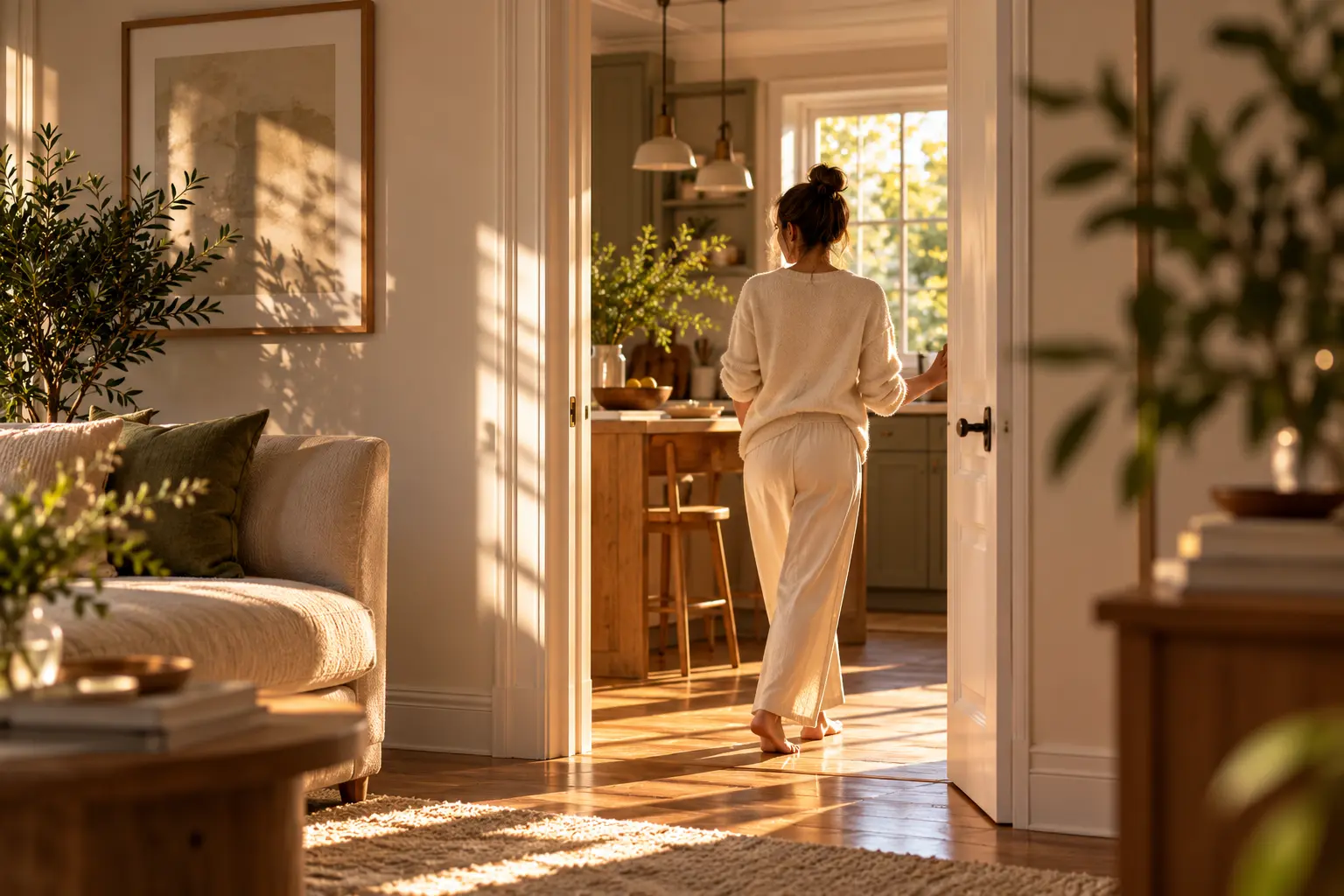
You get up from the sofa and head to the kitchen.
You walk through the doorway, stop for a second, look around and think:
Wait… what did I come here for?
You stand there trying to remember. Maybe you open the fridge, hoping it'll give you a clue. Nothing.
Then you walk back to the living room and suddenly remember.
Sound familiar?
It's one of those funny little moments we all experience. But what's particularly interesting is that the doorway itself might have something to do with it.
The doorway effect: when changing rooms changes context
Researchers have studied a phenomenon known as the doorway effect.
In certain situations, walking from one room into another can make it harder to remember something we were just thinking about.
Why?
One explanation comes from a concept in cognitive psychology called event segmentation.
Our minds don't experience everything as one continuous, uninterrupted story. Instead, we organise our experiences into smaller events.
Making breakfast. Answering emails. Having a conversation. Moving from one room to another.
These events have beginnings and endings, and our surroundings can help define them.
A doorway is one of those physical boundaries that may signal a change of context.
As we enter a new room, our mind may begin processing a new event, making information connected to the previous one a little harder to retrieve.
It's almost like turning a page in a book.
The previous page hasn't disappeared. We're simply paying attention to a new one.
Of course, this doesn't happen every time we cross a doorway. Research suggests that context, memory demands and cognitive load all play a role.
Still, it's a fascinating reminder that even something as ordinary as moving between rooms can interact with the way we think.
A doorway is more than an opening
In architecture and interior design, we usually think about doorways in practical terms.
They connect spaces, organise circulation, provide privacy and separate functions.
But a doorway can also represent a transition between two different experiences.
Think about moving from a busy kitchen into a quiet bedroom.
Or leaving an open plan office to enter a small, enclosed focus room.
Or walking from a lively hotel lobby into a softly lit spa.
In each case, we're not simply changing our physical location.
We're entering an environment with different expectations, activities and sensory conditions.
And the transition itself can help us recognise that change.
Designing the moments in between
When we design a space, it's natural to focus on the rooms themselves.
How should the living room feel? Where should the workspace be positioned? What lighting would work best in the bedroom?
But what about the moments between those spaces?
The doorway. The corridor. The change in flooring. The shift from bright light to softer illumination.
These details may seem secondary, yet they help shape how we move through and understand an environment.
Consider a workspace designed for both collaboration and concentration.
A transition from a lively shared area to a quiet focus zone might be supported by a change in acoustics, lighting, visual complexity or enclosure.
In a home, the passage from a work area to a place of rest might be made more distinct through spatial separation and sensory cues.
In hospitality, a gradual transition from a busy entrance to a calmer interior can help establish a different atmosphere.
None of this means that a particular doorway design will improve memory or prevent distraction. The research on the doorway effect doesn't establish that.
Rather, it invites us to think more carefully about how physical boundaries and changes in context contribute to the experience of a place.
Sometimes a transition should feel clear and deliberate.
Other times, it should feel almost invisible.
The interesting design question is knowing when each approach makes sense.
What happens between spaces matters, too
At Mind Friendly Spaces, I'm interested in the relationship between our environments and the way we feel, think and behave within them.
The doorway effect is a small but intriguing example of that relationship.
It doesn't give us a ready made design rule. Instead, it raises a question worth exploring:
If moving from one space to another can influence how we organise experiences, shouldn't we pay more attention to the transitions we create?
Perhaps thoughtful spatial design isn't only about creating beautiful or functional rooms.
It's also about considering the journey between them.
Because sometimes, the most interesting part of a space isn't the room itself.
It's what happens as we move from one to another.
And next time you walk into the kitchen and forget why you're there?
Maybe give yourself a moment before blaming your memory.
Your mind might just be turning a page.
A little science behind this note
The doorway effect has been investigated in cognitive psychology through studies of memory and changes in location.
Further reading
Radvansky, G. A., & Copeland, D. E. (2006). Walking through doorways causes forgetting: Situation models and experienced space. Memory & Cognition, 34, 1150–1156.
Radvansky, G. A., & Krawietz, S. A. (2011). Walking through doorways causes forgetting: Further explorations. Quarterly Journal of Experimental Psychology, 64(8), 1632–1645.
Radvansky, G. A., & Copeland, D. E. (2011). Walking through doorways causes forgetting: Event structure or updating disruption? Quarterly Journal of Experimental Psychology, 64(4), 609–614.
These studies explore relationships between event boundaries and memory. They should not be interpreted as evidence that specific architectural design choices directly improve cognitive performance.
Vous vous levez du canapé et vous dirigez vers la cuisine.
Vous franchissez la porte, vous arrêtez un instant, regardez autour de vous et pensez :
Attendez… pourquoi suis-je venu ici ?
Vous restez là, à essayer de vous souvenir. Peut-être ouvrez-vous le réfrigérateur dans l’espoir qu’il vous donne un indice. Rien.
Puis vous retournez au salon et, tout à coup, cela vous revient.
Ça vous dit quelque chose ?
C’est le genre de petite scène amusante que tout le monde connaît. Mais le plus étonnant, c’est que la porte elle-même pourrait y être pour quelque chose.
L’effet de porte : quand changer de pièce change aussi le contexte
Des chercheurs se sont intéressés à un phénomène appelé l’effet de porte, ou doorway effect.
Dans certaines situations, passer d’une pièce à une autre peut rendre plus difficile le rappel de ce à quoi l’on pensait juste avant.
Pourquoi ?
L’une des pistes d’explication vient d’un concept de psychologie cognitive appelé segmentation événementielle.
Notre esprit ne vit pas tout comme un seul récit continu. Il organise plutôt ce que nous faisons en une succession de petits événements.
Préparer le petit déjeuner. Répondre à ses mails. Avoir une conversation. Passer d’une pièce à une autre.
Ces événements ont un début et une fin, et l’environnement peut nous aider à les délimiter.
Une porte fait partie de ces frontières physiques susceptibles de signaler un changement de contexte.
Lorsque nous entrons dans une nouvelle pièce, notre esprit peut commencer à traiter un nouvel événement. Les informations liées au précédent deviennent alors un peu moins faciles à retrouver.
C’est un peu comme tourner la page d’un livre.
La page précédente n’a pas disparu. Notre attention s’est simplement portée sur la suivante.
Bien sûr, cela ne se produit pas chaque fois que nous franchissons une porte. Les recherches montrent que le contexte, ce que la mémoire doit retenir et la charge cognitive ont tous leur importance.
Il reste fascinant de constater qu’un geste aussi banal que passer d’une pièce à une autre peut interagir avec notre façon de penser.
Une porte est bien plus qu’un simple passage
En architecture et en design d’intérieur, nous pensons généralement aux portes de manière très pratique.
Elles relient les espaces, organisent la circulation, préservent l’intimité et séparent les usages.
Mais une porte peut aussi marquer la transition entre deux expériences différentes.
Pensez au passage d’une cuisine animée à une chambre calme.
Ou au moment où l’on quitte un bureau ouvert pour entrer dans une petite pièce fermée, dédiée à la concentration.
Ou encore lorsque l’on passe du hall vivant d’un hôtel à un spa baigné d’une lumière douce.
Dans chacun de ces cas, nous ne changeons pas seulement d’endroit.
Nous entrons dans un environnement associé à d’autres attentes, d’autres activités et d’autres conditions sensorielles.
La transition elle-même peut nous aider à percevoir ce changement.
Penser les moments de transition
Lorsque nous concevons un espace, il est naturel de nous concentrer sur les pièces elles-mêmes.
Quelle atmosphère donner au salon ? Où installer l’espace de travail ? Quel éclairage conviendrait le mieux à la chambre ?
Mais qu’en est-il des moments entre ces espaces ?
La porte. Le couloir. Le changement de revêtement de sol. Le passage d’une lumière vive à une ambiance plus douce.
Ces détails peuvent sembler secondaires. Pourtant, ils participent à la manière dont nous traversons et comprenons un lieu.
Imaginons un espace de travail conçu à la fois pour collaborer et se concentrer.
Le passage d’une zone commune animée à un espace calme peut être accompagné par une évolution de l’acoustique, de la lumière, de la complexité visuelle ou du degré d’enveloppement.
À la maison, la transition entre un coin de travail et un lieu de repos peut devenir plus nette grâce à une séparation spatiale et à quelques repères sensoriels.
Dans un hôtel, un passage progressif entre une entrée très fréquentée et un intérieur plus calme peut contribuer à installer une autre atmosphère.
Rien de tout cela ne signifie qu’un certain type de porte améliorera la mémoire ou empêchera la distraction. Les recherches sur l’effet de porte ne permettent pas de l’affirmer.
Elles nous invitent plutôt à réfléchir avec davantage d’attention à la manière dont les limites physiques et les changements de contexte participent à l’expérience d’un lieu.
Parfois, une transition gagne à être claire et assumée.
À d’autres moments, elle peut presque disparaître.
La vraie question de conception consiste à savoir quand chacune de ces approches a du sens.
Ce qui se passe entre les espaces compte aussi
À travers Mind Friendly Spaces, je m’intéresse à la relation entre nos environnements et la manière dont nous nous y sentons, pensons et agissons.
L’effet de porte en est un exemple discret, mais particulièrement intéressant.
Il ne nous livre pas une règle de design toute faite. Il soulève plutôt une question qui mérite d’être explorée :
Si le passage d’un espace à un autre peut influencer la façon dont nous organisons nos expériences, ne devrions-nous pas accorder davantage d’attention aux transitions que nous créons ?
Peut-être qu’une conception attentive ne consiste pas seulement à créer des pièces belles ou fonctionnelles.
Elle consiste aussi à penser au chemin qui les relie.
Parce que, parfois, la partie la plus intéressante d’un lieu n’est pas la pièce elle-même.
C’est ce qui se passe lorsque nous passons de l’une à l’autre.
Et la prochaine fois que vous entrez dans la cuisine sans savoir pourquoi ?
Accordez-vous peut-être quelques secondes avant d’accuser votre mémoire.
Votre esprit est peut-être simplement en train de tourner une page.
Un peu de science derrière cette note
L’effet de porte a été étudié en psychologie cognitive à travers des recherches portant sur la mémoire et les changements de lieu.
Pour aller plus loin
Radvansky, G. A., & Copeland, D. E. (2006). Walking through doorways causes forgetting: Situation models and experienced space. Memory & Cognition, 34, 1150–1156.
Radvansky, G. A., & Krawietz, S. A. (2011). Walking through doorways causes forgetting: Further explorations. Quarterly Journal of Experimental Psychology, 64(8), 1632–1645.
Radvansky, G. A., & Copeland, D. E. (2011). Walking through doorways causes forgetting: Event structure or updating disruption? Quarterly Journal of Experimental Psychology, 64(4), 609–614.
Ces études explorent les liens entre les frontières d’un événement et la mémoire. Elles ne doivent pas être interprétées comme la preuve que certains choix architecturaux améliorent directement les performances cognitives.