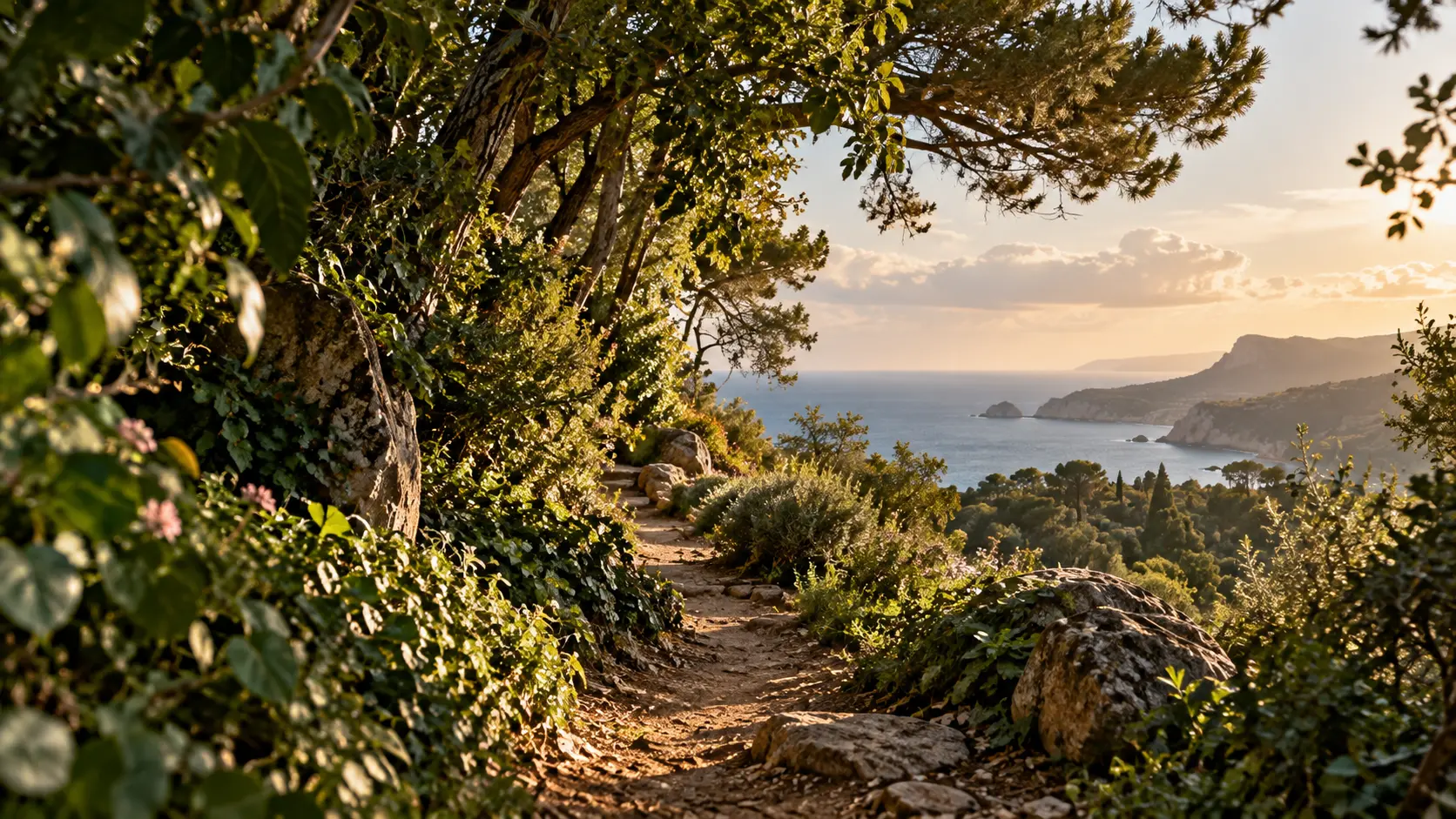
Imagine walking through a dense forest.
The trees are tall, vegetation surrounds the path and there is very little open space between you and what lies ahead.
For some people, this feels wonderful: immersive, quiet, almost protective.
For someone else, the very same place can feel uncomfortable. There may be too much happening around them. They may want to see further ahead, know what is behind the vegetation or simply have a little more sky above them.
Now imagine standing somewhere completely different.
A wide coastline. A meadow with a few scattered trees. A garden where nature is present, but paths and boundaries are easy to read.
These are all natural environments.
Psychologically, though, they do not necessarily offer the same experience.
Nature is not one kind of place
We often talk about nature as though it were a single thing.
We know that time in nature can help restore our attention, reduce stress and support wellbeing. A substantial body of research has explored the links between contact with natural environments and different aspects of physical and psychological health.
But the word nature covers an extraordinary range of environments.
A dense woodland is nature. So is an open field.
A wild coastline, an urban park, a carefully maintained garden and the tree outside your kitchen window all offer some form of contact with the natural world.
What changes is the experience they create.
The amount of enclosure. How far we can see. How complex the surroundings feel. Whether we know what is around the corner. Whether paths and boundaries are clear. How familiar the place feels to us.
Research into vegetation and landscape preferences offers an interesting example. Dense vegetation can sometimes reduce visibility and make the surroundings harder to read. In certain settings, this has been associated with lower perceived safety and different landscape preferences.
This does not mean that dense forests are somehow bad for us.
It simply reminds us that more nature does not automatically mean more comfort.
Sometimes we want nature. Sometimes we also want to see
There is something reassuring about a place that lets us feel surrounded without feeling completely enclosed.
A tree gives shade, but we can still see beyond it.
A garden surrounds us with vegetation, but we understand where the path leads.
A sheltered bench gives us somewhere to settle while leaving the landscape open in front of us.
Ideas around prospect and refuge have long helped us explore the balance between feeling protected and being able to observe our surroundings. Research continues to examine how openness, enclosure and visibility can influence landscape preference and perceived safety.
Even here, there is no perfect formula.
Some people love disappearing into dense vegetation.
Others relax when they can see the horizon.
The same person may want both, depending on where they are, what they are doing and how they feel that day.
Our relationship with nature is not only about what surrounds us. It is also about how we experience it.
So what happens when we bring nature indoors?
This is where biophilic design becomes particularly interesting.
It is sometimes reduced to a very simple idea: add plants.
A few plants become a green wall. The green wall becomes an indoor jungle. Suddenly the room is described as biophilic.
But our connection with nature can take many forms.
Natural light is one. A view towards trees or sky is another.
Natural materials, textures, airflow, changing shadows, organic forms and even the possibility of noticing weather and seasonal changes can all alter our relationship with an interior.
Research and biophilic design frameworks reflect this broader understanding. The field includes far more than vegetation alone, considering direct and indirect contact with nature as well as spatial experiences such as prospect and refuge.
A room filled with plants may feel rich, alive and restorative to one person, while someone else may prefer something quieter.
One plant may be enough.
Maybe what matters more is the daylight. Or the wooden floor. Or being able to look outside over breakfast. Or simply seeing a patch of sky from the sofa.
None of these relationships with nature is more authentic than another.
Biophilic design may need a different starting point
Instead of asking how we can put more nature into a space, we can first notice which aspects of nature we actually respond to.
- Where do you naturally slow down outside?
- Do you prefer being surrounded by trees or looking towards a distant horizon?
- Do you enjoy wild landscapes or places where nature feels slightly more ordered?
- At home, do plants make the room feel alive, or do you prefer nature to enter more quietly through light, materials and views?
There is no need for everyone to answer these questions in the same way. The differences may be the most interesting part.
At Mind Friendly Spaces, this is why we look not only at what an environment contains, but at the relationship a person develops with it.
Biophilic design does not have to mean creating as much contact with nature as possible. It can be more personal than that.
Not:
How can we add more nature?
But:
What kind of relationship with nature feels right here?
Further reading
Lis, A., Pardela, L., & Iwankowski, P. (2021). Why is dense vegetation in city parks unpopular? The mediative role of sense of privacy and safety. Urban Forestry & Urban Greening, 59, 126988. DOI: 10.1016/j.ufug.2021.126988.
Gillis, K. & Gatersleben, B. / biophilic design literature reviewed in: A systematic review and conceptual framework of biophilic design parameters in clinical environments. International Journal of Environmental Research and Public Health (2022). Includes daylight, air, plants, natural materials, prospect, refuge, mystery and other biophilic parameters.
Bowler, D. E., Buyung-Ali, L. M., Knight, T. M., & Pullin, A. S. (2010). A systematic review of evidence for the added benefits to health of exposure to natural environments. BMC Public Health, 10, 456. DOI: 10.1186/1471-2458-10-456.
Pardela, L., Beck, J., & Lis, A. (2025). Perception of urban parks: the influence of topography, vegetation density and park attributes on perceived safety, mystery and preference. Landscape Online, 100, 1133. DOI: 10.3097/LO.2025.1133.
Imaginez que vous avanciez dans une forêt dense.
Les arbres sont hauts, la végétation encadre le chemin et laisse peu d’espace ouvert entre vous et ce qui se trouve plus loin.
Pour certaines personnes, l’expérience est merveilleuse : immersive, silencieuse, presque protectrice.
Pour d’autres, le même lieu peut créer un léger inconfort. Il se passe peut-être trop de choses autour d’elles. Elles aimeraient voir plus loin, savoir ce qui se cache derrière la végétation ou simplement apercevoir un peu plus de ciel.
Imaginez maintenant un tout autre paysage.
Un vaste littoral. Une prairie ponctuée de quelques arbres. Un jardin où la nature est bien présente, mais où les chemins et les limites restent faciles à comprendre.
Tous ces lieux sont des environnements naturels.
Pourtant, sur le plan psychologique, ils ne proposent pas nécessairement la même expérience.
La nature n’est pas un seul type de lieu
Nous parlons souvent de la nature comme s’il s’agissait d’une seule et même chose.
Nous savons que passer du temps dans la nature peut aider notre attention à se régénérer, réduire le stress et soutenir notre bien-être. De nombreuses recherches ont exploré les liens entre le contact avec les environnements naturels et différents aspects de la santé physique et psychologique.
Mais le mot nature recouvre une diversité extraordinaire d’environnements.
Une forêt dense est la nature. Un champ ouvert aussi.
Un littoral sauvage, un parc urbain, un jardin soigneusement entretenu et l’arbre que l’on aperçoit depuis la cuisine nous mettent chacun en contact avec le monde naturel.
Ce qui change, c’est l’expérience qu’ils créent.
Le degré d’enveloppement. La distance à laquelle le regard peut porter. La complexité de ce qui nous entoure. Le fait de savoir ou non ce qui se trouve au détour du chemin. La lisibilité des limites et des parcours. La familiarité du lieu.
Les recherches sur la végétation et les préférences paysagères en donnent un exemple intéressant. Une végétation très dense peut parfois réduire la visibilité et rendre l’environnement plus difficile à lire. Dans certains contextes, elle a été associée à un sentiment de sécurité plus faible et à des préférences paysagères différentes.
Cela ne signifie pas que les forêts denses seraient mauvaises pour nous.
Cela nous rappelle simplement que davantage de nature ne signifie pas automatiquement davantage de confort.
Parfois, nous voulons être entourés de nature. Parfois, nous avons aussi besoin de voir
Un lieu peut nous envelopper sans nous donner la sensation d’être complètement enfermés. C’est souvent ce qui le rend rassurant.
Un arbre nous offre de l’ombre, tout en laissant le regard se prolonger au-delà.
Un jardin nous entoure de végétation, mais nous comprenons où mène le chemin.
Un banc abrité nous permet de nous poser tout en gardant le paysage ouvert devant nous.
Les notions de perspective et de refuge sont depuis longtemps utilisées pour explorer cet équilibre entre le fait de se sentir protégé et la possibilité d’observer ce qui nous entoure. Les recherches continuent d’étudier l’influence de l’ouverture, de l’enveloppement et de la visibilité sur nos préférences paysagères et notre sentiment de sécurité.
Là encore, il n’existe pas de formule parfaite.
Certaines personnes aiment disparaître dans une végétation dense.
D’autres se détendent lorsqu’elles peuvent voir l’horizon.
Une même personne peut rechercher l’un ou l’autre selon le lieu, l’activité ou son état du jour.
Notre relation à la nature ne dépend pas seulement de ce qui nous entoure. Elle dépend aussi de la manière dont nous le vivons.
Que se passe-t-il lorsque nous faisons entrer la nature à l’intérieur ?
C’est là que le design biophilique devient particulièrement intéressant.
On le résume parfois à une idée très simple : ajouter des plantes.
Quelques plantes deviennent un mur végétal. Le mur végétal se transforme en jungle intérieure. Et soudain, la pièce est qualifiée de biophilique.
Pourtant, notre lien avec la nature peut prendre bien d’autres formes.
La lumière naturelle en est une. Une vue sur les arbres ou le ciel en est une autre.
Les matériaux naturels, les textures, la circulation de l’air, les ombres changeantes, les formes organiques ou encore la possibilité d’observer la météo et le passage des saisons peuvent tous modifier notre relation à un intérieur.
Les recherches et les cadres du design biophilique reflètent cette vision plus large. Le domaine va bien au-delà de la végétation et considère différentes formes de contact direct ou indirect avec la nature, mais aussi des expériences spatiales telles que la perspective et le refuge.
Une pièce remplie de plantes peut sembler riche, vivante et ressourçante à une personne, tandis qu’une autre préférera une présence plus discrète.
Une seule plante peut suffire.
Peut-être que la lumière du jour compte davantage. Ou le parquet en bois. Ou la possibilité de regarder dehors au petit-déjeuner. Ou simplement ce morceau de ciel visible depuis le canapé.
Aucune de ces relations à la nature n’est plus authentique qu’une autre.
Le design biophilique mérite peut-être un autre point de départ
Au lieu de nous demander comment ajouter davantage de nature dans un espace, nous pouvons commencer par observer les aspects de la nature auxquels nous sommes réellement sensibles.
- Dans quels lieux ralentissez-vous naturellement lorsque vous êtes dehors ?
- Préférez-vous être entouré d’arbres ou regarder vers un horizon lointain ?
- Aimez-vous les paysages sauvages ou les lieux où la nature paraît un peu plus ordonnée ?
- Chez vous, les plantes rendent-elles la pièce plus vivante, ou préférez-vous que la nature s’y glisse plus discrètement par la lumière, les matériaux et les vues ?
Nous n’avons pas besoin de répondre tous de la même manière. Ces différences sont peut-être justement ce qu’il y a de plus intéressant.
Chez Mind Friendly Spaces, nous nous intéressons donc autant à ce qu’un environnement contient qu’à la relation que chacun développe avec lui.
Le design biophilique ne consiste pas forcément à multiplier les contacts avec la nature. Il peut être bien plus personnel que cela.
La question n’est pas :
Comment ajouter davantage de nature ?
Mais plutôt :
Quelle relation à la nature semble juste ici ?
Pour aller plus loin
Lis, A., Pardela, L., & Iwankowski, P. (2021). Why is dense vegetation in city parks unpopular? The mediative role of sense of privacy and safety. Urban Forestry & Urban Greening, 59, 126988. DOI: 10.1016/j.ufug.2021.126988.
Gillis, K. & Gatersleben, B. / littérature sur le design biophilique étudiée dans : A systematic review and conceptual framework of biophilic design parameters in clinical environments. International Journal of Environmental Research and Public Health (2022). L’étude inclut notamment la lumière du jour, l’air, les plantes, les matériaux naturels, la perspective, le refuge et le mystère.
Bowler, D. E., Buyung-Ali, L. M., Knight, T. M., & Pullin, A. S. (2010). A systematic review of evidence for the added benefits to health of exposure to natural environments. BMC Public Health, 10, 456. DOI: 10.1186/1471-2458-10-456.
Pardela, L., Beck, J., & Lis, A. (2025). Perception of urban parks: the influence of topography, vegetation density and park attributes on perceived safety, mystery and preference. Landscape Online, 100, 1133. DOI: 10.3097/LO.2025.1133.