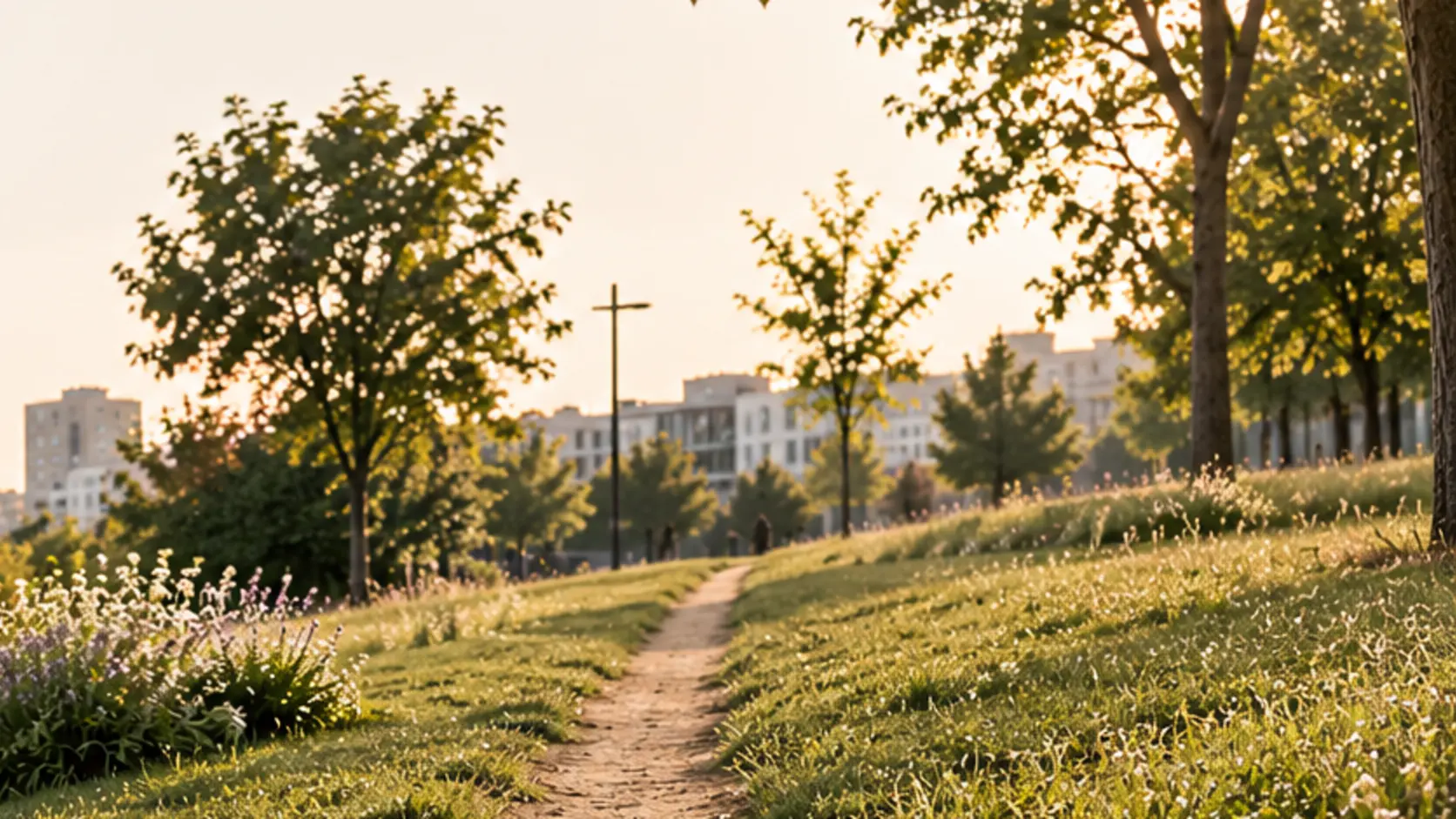
You're walking through a park.
There's a perfectly good paved path ahead of you. It curves gently around a patch of grass, passing a few trees and benches along the way.
But then you notice something else.
A narrow strip of bare earth cuts straight across the grass, connecting two points that the paved path takes a little longer to reach.
Someone has walked there before. Actually, quite a few people have.
And without giving it much thought, you take that route too.
It might seem like a small, unremarkable decision. But that little shortcut tells us something interesting about the relationship between people and the spaces we design.
The path nobody planned
These informal shortcuts have a name: desire paths.
You'll find them in parks, university campuses, residential neighbourhoods and sometimes even between buildings in busy city centres.
They appear gradually, as people repeatedly walk along a route that wasn't originally intended as a path. Over time, the grass wears away and the ground begins to reveal a new line.
It's almost as though the landscape has been quietly keeping a record of people's movements.
Why do these paths appear?
Sometimes the answer is simple: people want to get somewhere faster.
But not every shortcut is just about saving a few seconds.
A route might feel more direct, easier to follow or better connected to where someone actually wants to go. It might reflect a daily routine that the original layout didn't fully anticipate.
And sometimes, people simply follow a route because others have already made it visible.
Whatever the reason, these small decisions accumulate.
Eventually, an individual choice becomes a shared pattern.
When the drawing meets real life
A landscape architect or urban planner might spend months considering how people will move through a public space.
Paths are carefully positioned. Connections are studied. Distances, accessibility, planting and circulation all play a part.
And then the space opens.
People arrive with their own routines, priorities and habits.
Someone is running late for work. Someone else is walking towards a bus stop. A student crosses the same lawn every morning because it's the most convenient way to reach a building.
The space begins to develop a life beyond the original drawing.
This doesn't necessarily mean the design was wrong.
A desire path can emerge for many reasons, and the shortest route isn't always the safest or most accessible one.
But it does offer something valuable: a visible clue about how people are actually using a place.
Instead of seeing an informal path simply as something to prevent, we can ask what it might be telling us.
Where are people trying to go?
Which connections feel natural to them?
Is there a need that the planned layout hasn't fully addressed?
Sometimes, observing what happens after a space is built can be just as revealing as studying it before construction begins.
The invisible paths inside our homes
Now imagine the same idea on a much smaller scale.
Think about your home.
Perhaps there's a chair you always move slightly to one side because it makes walking through the room easier.
Maybe you keep leaving your keys on a particular shelf, even though you've carefully designated another place for them.
Or perhaps there's a corner of your living room where everyone naturally gathers, despite the seating arrangement suggesting otherwise.
These aren't desire paths in the literal sense.
But they reveal a similar relationship between spatial design and everyday behaviour.
We adapt our surroundings, sometimes without even noticing.
We create routines around the places that feel convenient, familiar or comfortable. We avoid awkward transitions. We rearrange objects to make daily activities easier.
And over time, the way we use a space may become quite different from the way it was originally imagined.
A beautiful floor plan can tell us where furniture belongs.
But it cannot always predict where someone will prefer to sit with their morning coffee, where a family will naturally gather or which corner of a workspace will become an informal meeting spot.
Those things often become clear only when people begin living in the space.
What happens when we start observing?
This is one of the questions that makes environmental psychology so interesting.
Rather than looking only at the physical characteristics of a place, it encourages us to consider the relationship between the environment and the people experiencing it.
How do people navigate a space?
Where do they choose to spend time?
What do they avoid?
What do they change?
In architecture and urban design, observing how a place is used after it has been built is part of what is known as post occupancy evaluation.
It's a way of learning from real experience rather than relying entirely on what was expected during the design process.
And that idea doesn't have to be limited to large architectural projects.
Even in our own homes, paying attention to everyday habits can reveal useful things about how a space supports us, or where it creates unnecessary friction.
Perhaps the furniture doesn't need replacing. Perhaps it simply needs to move.
Perhaps a room isn't being used as intended because its layout doesn't suit the activities that actually happen there.
Or perhaps a small adjustment could make an everyday routine feel much easier.
The interesting part is that the clues are often already there.
We just don't always notice them.
Designing with people, not just for them
There's something quietly fascinating about desire paths.
They remind us that people aren't passive occupants of designed environments.
We interact with spaces, interpret them, adapt to them and sometimes reshape them.
A park might be carefully planned, but the people walking through it continue to influence how it functions.
A home might be thoughtfully furnished, but the people living there gradually give it its own rhythm.
And a workplace might be organised around a particular idea of collaboration, while employees develop entirely different patterns of interaction.
None of this means design should simply follow every habit or shortcut. Good design also needs to consider safety, accessibility, environmental impact and the needs of different users.
But it does suggest that observation deserves a place alongside imagination.
Because understanding how people actually experience an environment can reveal things that drawings, measurements and visualisations alone may not show.
Perhaps the most interesting question isn't always:
Not only:
How should people use this space?
But sometimes:
How are people already using it, and what can we learn from that?
A space doesn't stop evolving when the design is finished.
People continue to shape it through their movements, routines and everyday choices.
And sometimes, the most valuable design insight isn't hidden in a complicated drawing or a detailed report.
It's right there, worn into the grass.
Vous traversez un parc.
Devant vous, un chemin pavé parfaitement praticable. Il contourne doucement une pelouse et passe près de quelques arbres et bancs.
Puis vous remarquez autre chose.
Une étroite bande de terre nue traverse l’herbe en ligne droite. Elle relie deux points que le chemin aménagé met un peu plus de temps à rejoindre.
Quelqu’un est déjà passé par là. En réalité, beaucoup de monde.
Et sans vraiment y réfléchir, vous empruntez ce passage à votre tour.
Cette décision peut sembler anodine. Pourtant, ce petit raccourci dit quelque chose d’intéressant sur la relation entre les personnes et les espaces que nous concevons.
Le chemin que personne n’avait dessiné
Ces raccourcis spontanés portent un nom : les chemins de désir.
On les trouve dans les parcs, sur les campus universitaires, dans les quartiers résidentiels et parfois même entre les immeubles des centres-villes très fréquentés.
Ils apparaissent peu à peu, à force de passages répétés sur un itinéraire qui n’avait pas été prévu comme un chemin. L’herbe finit par s’effacer et le sol laisse apparaître une nouvelle ligne.
Comme si le paysage conservait discrètement la trace des déplacements humains.
Pourquoi ces chemins se forment-ils ?
La réponse est parfois toute simple : on cherche à arriver plus vite.
Mais tous les raccourcis ne servent pas uniquement à gagner quelques secondes.
Un trajet peut sembler plus direct, plus lisible ou mieux relié à l’endroit où l’on souhaite réellement aller. Il peut aussi révéler une habitude quotidienne que le plan initial n’avait pas totalement anticipée.
Il arrive également que l’on suive un passage simplement parce que d’autres l’ont déjà rendu visible.
Quelle qu’en soit la raison, ces petites décisions s’additionnent.
Un choix individuel finit alors par devenir un usage partagé.
Quand le dessin rencontre la réalité
Un paysagiste ou un urbaniste peut passer des mois à réfléchir à la manière dont les personnes circuleront dans un espace public.
Les chemins sont soigneusement tracés. Les connexions sont étudiées. Les distances, l’accessibilité, les plantations et les déplacements entrent tous en ligne de compte.
Puis le lieu ouvre au public.
Les personnes arrivent avec leurs propres habitudes, priorités et contraintes.
L’une est en retard au travail. Une autre se dirige vers un arrêt de bus. Chaque matin, un étudiant traverse la même pelouse parce que c’est le moyen le plus simple d’atteindre son bâtiment.
Le lieu commence alors à développer une vie qui dépasse le dessin initial.
Cela ne signifie pas nécessairement que la conception était mauvaise.
Un chemin de désir peut apparaître pour de nombreuses raisons, et le trajet le plus court n’est pas toujours le plus sûr ni le plus accessible.
Mais il offre une information précieuse : un indice visible de la façon dont les personnes utilisent réellement le lieu.
Plutôt que de considérer un passage informel comme un problème à empêcher, nous pouvons nous demander ce qu’il cherche à nous dire.
Où les personnes essaient-elles d’aller ?
Quelles connexions leur paraissent naturelles ?
Le plan prévu a-t-il laissé de côté un besoin réel ?
Observer ce qui se passe après la réalisation d’un espace peut parfois être aussi révélateur que de l’étudier avant le début des travaux.
Les chemins invisibles de nos intérieurs
Imaginons maintenant la même idée à une échelle beaucoup plus petite.
Pensez à votre intérieur.
Peut-être déplacez-vous toujours légèrement une chaise parce que cela rend le passage plus facile.
Peut-être continuez-vous à poser vos clés sur une certaine étagère, même si vous leur avez soigneusement prévu une autre place.
Ou peut-être existe-t-il un coin du salon où tout le monde se rassemble naturellement, malgré une disposition des sièges qui semblait suggérer autre chose.
Ce ne sont pas des chemins de désir au sens littéral.
Mais ils révèlent une relation comparable entre l’aménagement d’un espace et les comportements du quotidien.
Nous adaptons ce qui nous entoure, parfois sans même nous en rendre compte.
Nous créons des habitudes autour des endroits qui nous semblent pratiques, familiers ou confortables. Nous évitons les passages peu fluides. Nous déplaçons les objets pour faciliter les gestes de tous les jours.
Avec le temps, notre façon d’utiliser un lieu peut devenir assez différente de celle qui avait été imaginée au départ.
Un beau plan peut indiquer où placer les meubles.
Mais il ne peut pas toujours prévoir où une personne préférera boire son café le matin, où une famille se réunira spontanément ni quel coin d’un espace de travail deviendra un lieu de discussion informel.
Ces choses ne deviennent souvent visibles qu’une fois que les personnes commencent réellement à vivre dans l’espace.
Et si l’on commençait par observer ?
C’est l’une des questions qui rendent la psychologie environnementale si intéressante.
Plutôt que de regarder uniquement les caractéristiques physiques d’un lieu, elle nous invite à considérer la relation entre l’environnement et les personnes qui en font l’expérience.
Comment les personnes se déplacent-elles dans l’espace ?
Où choisissent-elles de passer du temps ?
Qu’évitent-elles ?
Que modifient-elles ?
En architecture et en urbanisme, l’observation d’un lieu une fois construit relève de ce que l’on appelle l’évaluation après occupation.
Cette démarche permet d’apprendre de l’expérience réelle, au lieu de s’appuyer uniquement sur ce qui avait été anticipé pendant la conception.
Et cette idée ne se limite pas aux grands projets architecturaux.
Chez nous aussi, observer nos habitudes quotidiennes peut nous apprendre beaucoup sur la façon dont un espace nous soutient ou, au contraire, crée des difficultés inutiles.
Peut-être que le mobilier n’a pas besoin d’être remplacé. Il suffit peut-être de le déplacer.
Peut-être qu’une pièce n’est pas utilisée comme prévu parce que son agencement ne correspond pas aux activités qui s’y déroulent réellement.
Ou peut-être qu’un petit ajustement rendrait une routine quotidienne beaucoup plus simple.
Le plus intéressant, c’est que les indices sont souvent déjà là.
Nous ne les remarquons simplement pas toujours.
Concevoir avec les personnes, et pas seulement pour elles
Les chemins de désir ont quelque chose de discrètement fascinant.
Ils nous rappellent que les personnes ne sont pas les occupantes passives d’environnements conçus pour elles.
Nous interagissons avec les lieux, nous les interprétons, nous nous y adaptons et nous les transformons parfois.
Un parc peut avoir été soigneusement planifié, mais les personnes qui le traversent continuent d’influencer son fonctionnement.
Un intérieur peut avoir été aménagé avec attention, mais celles et ceux qui y vivent lui donnent peu à peu son propre rythme.
Et un lieu de travail peut être organisé autour d’une certaine idée de la collaboration, tandis que les équipes développent des manières d’échanger tout à fait différentes.
Cela ne signifie pas que la conception doit suivre chaque habitude ou chaque raccourci. Un bon projet doit aussi tenir compte de la sécurité, de l’accessibilité, de l’impact environnemental et des besoins de différents usagers.
Mais cela suggère que l’observation mérite sa place aux côtés de l’imagination.
Comprendre comment les personnes vivent réellement un environnement peut révéler des choses que les plans, les mesures et les visualisations ne montrent pas toujours.
La question la plus intéressante n’est peut-être pas toujours :
Pas seulement :
Comment les personnes devraient-elles utiliser cet espace ?
Mais parfois :
Comment l’utilisent-elles déjà, et que pouvons-nous en apprendre ?
Un espace ne cesse pas d’évoluer une fois la conception terminée.
Les personnes continuent à le façonner par leurs déplacements, leurs habitudes et leurs choix quotidiens.
Et parfois, l’enseignement le plus précieux ne se cache ni dans un dessin complexe ni dans un rapport détaillé.
Il est juste là, inscrit dans l’herbe.