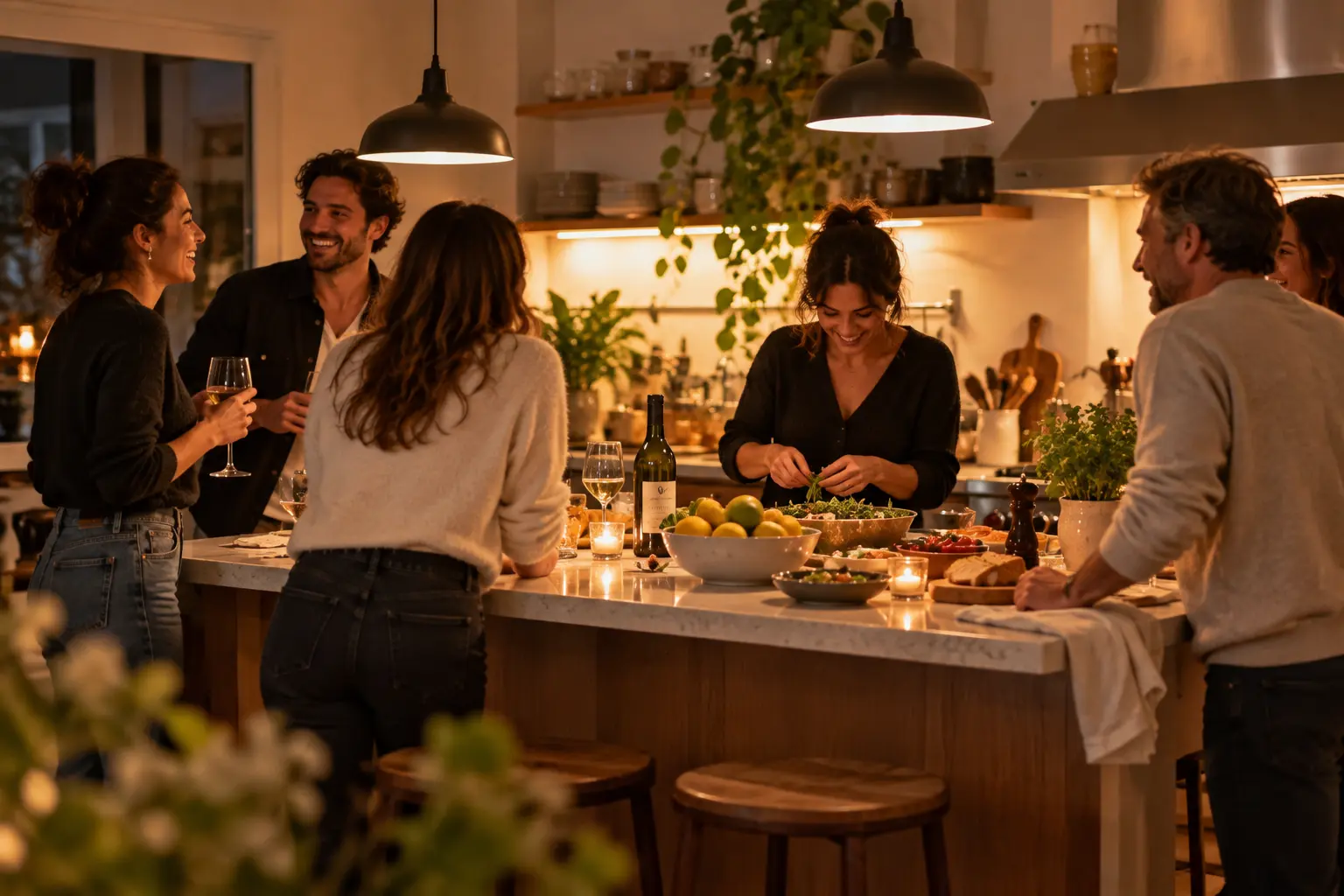
You prepared the living room. Everyone is standing in the kitchen.
You tidied the living room. Fluffed the cushions. Dimmed the lights. Maybe even lit a candle.
Then the guests arrive.
Twenty minutes later, half of them are standing around the kitchen counter.
Why?
It feels like one of those unwritten rules of having people over. But the kitchen often has a few things going for it that a carefully arranged living room does not.
The kitchen gives us something to do
Walking into a room full of people and simply sitting down to socialise can feel surprisingly formal.
The kitchen is different. Someone is opening a bottle. Someone else is looking for glasses. Food is being prepared, plates are moving, people come and go.
All of those small activities give interaction a purpose. We do not have to immediately perform the role of “guest”. We can help, lean, watch, taste, move around or simply stand nearby.
Sometimes conversation feels easier when conversation is not the only thing we are supposed to be doing.
Standing changes the social dynamic
Living rooms often organise us before we have decided where we want to be. Sofas face certain directions. Armchairs create positions. Once people sit down, little groups can form and become surprisingly awkward to enter or leave.
Around a kitchen island or counter, things are usually more fluid. People can turn towards one another, shift position, join a conversation and drift away again without making an announcement.
The social arrangement can keep changing because the space makes movement easy.
We like being close to where things are happening
The kitchen is often an active point in the home. Food appears there. Drinks are replenished there. The host keeps returning there. People pass through it.
That activity can create a natural social pull. Standing nearby lets us feel involved, even when we are doing absolutely nothing useful.
Yes, holding a glass next to the person chopping lemons apparently counts as participation.
And then there are the edges
People do not always choose the most impressive position in a room. We often gravitate towards places that give us a little support or orientation: a wall behind us, the edge of a counter, a corner to lean against.
Kitchens tend to offer plenty of these small spatial anchors. They let us take part without necessarily feeling as though we are standing in the middle of the room.
For some people, that small difference can make socialising feel easier.
So, is the kitchen secretly the best designed room in the house?
Not necessarily.
Food matters. Habit matters. Culture matters. So do the host, the guests and the layout of the particular home. There is no universal rule saying that people are destined to gather around a kitchen island.
Still, the familiar party kitchen reveals something interesting about space: social comfort is not only about providing somewhere to sit.
It can also come from giving people different ways to participate. A place to lean. Something to do. An easy way into a conversation. And an equally easy way out of one.
Perhaps that is why the room designed for cooking so often becomes the room where everyone ends up talking.
Sometimes the most social space isn't the one designed for socialising.
Vous aviez préparé le salon. Tout le monde est dans la cuisine.
Vous avez rangé le salon. Remis les coussins en place. Baissé la lumière. Peut-être même allumé une bougie.
Puis les invités arrivent.
Vingt minutes plus tard, la moitié d’entre eux est debout autour du plan de travail de la cuisine.
Pourquoi ?
On dirait presque une règle non écrite des soirées entre amis. Pourtant, la cuisine a souvent quelques atouts que le salon, pourtant soigneusement préparé, n’a pas.
Dans la cuisine, on a quelque chose à faire
Entrer dans une pièce pleine de monde et simplement s’asseoir pour discuter peut être étonnamment formel.
Dans la cuisine, c’est différent. Quelqu’un ouvre une bouteille. Une autre personne cherche des verres. On prépare quelque chose, les assiettes circulent, les gens entrent et sortent.
Toutes ces petites activités donnent un prétexte naturel à l’interaction. On n’a pas besoin de prendre immédiatement sa place d’« invité ». On peut aider, s’appuyer contre le plan de travail, regarder, goûter, bouger ou simplement rester à côté.
Parfois, la conversation vient plus facilement quand discuter n’est pas la seule chose que l’on est censé faire.
Debout, les échanges deviennent plus fluides
Un salon nous place souvent avant même que nous ayons décidé où nous voulons être. Les canapés regardent dans certaines directions. Les fauteuils créent des positions. Une fois assis, de petits groupes se forment et il peut devenir étonnamment difficile de les rejoindre ou de les quitter naturellement.
Autour d’un îlot ou d’un plan de travail, les choses sont souvent plus souples. On peut se tourner vers quelqu’un, changer de place, entrer dans une conversation puis s’en éloigner sans avoir l’impression d’annoncer son départ.
La configuration sociale peut évoluer en permanence parce que l’espace laisse le mouvement se faire facilement.
On aime rester près de là où il se passe quelque chose
La cuisine est souvent un point actif de la maison. C’est là que la nourriture arrive, que l’on ressert les boissons, que l’hôte revient régulièrement et que les gens passent.
Cette activité peut créer une sorte d’attraction sociale. Rester à proximité permet de se sentir impliqué, même lorsqu’on ne fait absolument rien d’utile.
Oui, tenir son verre à côté de la personne qui coupe les citrons compte apparemment comme une participation.
Et puis, il y a les bords
Nous ne choisissons pas toujours l’endroit le plus spectaculaire d’une pièce. Nous avons souvent tendance à nous rapprocher de lieux qui nous donnent un peu d’appui ou de repères : un mur derrière nous, le bord d’un plan de travail, un coin contre lequel s’adosser.
Les cuisines offrent souvent beaucoup de ces petits points d’ancrage. Ils permettent de participer sans avoir nécessairement l’impression d’être planté au milieu de la pièce.
Pour certaines personnes, cette petite différence suffit à rendre les échanges plus faciles.
Alors, la cuisine serait-elle secrètement la pièce la mieux pensée de la maison ?
Pas forcément.
La nourriture compte. Les habitudes aussi. La culture, l’hôte, les invités et la configuration du logement jouent tous un rôle. Il n’existe évidemment aucune règle universelle selon laquelle nous serions destinés à nous retrouver autour d’un îlot de cuisine.
Mais cette scène si familière dit quelque chose d’intéressant sur l’espace : le confort social ne consiste pas seulement à prévoir un endroit où s’asseoir.
Il peut aussi venir du fait d’offrir plusieurs façons de participer. Un endroit où s’appuyer. Quelque chose à faire. Une manière simple d’entrer dans une conversation. Et une manière tout aussi simple d’en sortir.
C’est peut-être pour cela que la pièce conçue pour cuisiner devient si souvent celle où tout le monde finit par discuter.
Parfois, l’espace le plus convivial n’est pas celui qui a été conçu pour recevoir.